Chapter 27: Gold, Diamonds and CS5
(the origin of everything)
Sometimes referred to as the "TED talk version" of the book, this is the chapter where all the arguments come together, and a philosophical realization about 'what' the universe is, is finally revealed.

Chapter Art for Part III "Origins"
At what point does chemistry become biology? And how did our species end up becoming the most dominant species on the planet? Find out the answer to these riddles and more inside Chapter 27's breakdown of the history of our universe.
The Singularity
This is a simple depiction of "the singularity" what our universe is supposed to have looked like 13.82 billion years ago just after it popped into existence. According to the standard model of cosmology, everything that is or ever will be was once contained inside a space much smaller than an atom.


The Cosmic Microwave Background Radiation
Taken by the Planck satellite, this is what the early universe looked like 380,000 years ago. It is, quite simply, the earliest "baby photo" of the universe that we have. If you look closely, you'll notice tiny temperature fluctuations that would eventually give rise to stars, galaxies, and galaxy clusters.
A Map of our Solar System
4.6 billion years ago, our sun was just starting to form. And as it started whipping up all the dust and debris around it, it gave rise to rocks, asteroids, planets, and moons. ***Note: The early universe would've looked a lot more chaotic than it does now.


Simplified Phylogenetic Tree
A simplified phylogenetic tree showing how bacteria, archaea, and eukaryotes all diverged from a common ancestor. This last universal common ancestor, called "LUCA" probably lived in hydrothermal vents deep in the ocean floor.
Image Credit: Madeleine Price Ball
A Metaphor for Evolution
If we were to imagine squeezing playdough out from the center of this ball, what might we expect to happen? Well, it would come out looking like a star on one side, and a rhombus on the other side, and a triangle on the front side, and this is a lovely way to conceptualize what the environment does for us. The environment "sets up the shapes"and life 'finds a way.'


A raspberry bush "suckering"
This is an example of asexual reproduction. A "parent" raspberry bush sends out an underground root called a shoot, which grows out a few feet from the old raspberry bush and gives rise to a "new" raspberry bush.
A collection of Aspen trees
In Utah, there's this species of trees that look like this. It's a great big forest of trees that spans for over a hundred acres, and we used to think that these were all seperate, living trees until one day...
%20Large.jpeg)
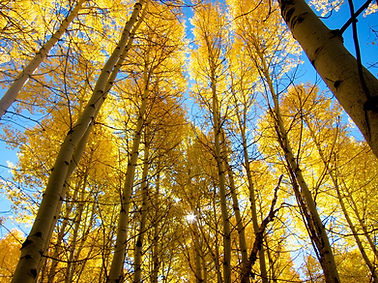
More Aspen trees
...someone looked under the ground and discovered that they weren’t all separate trees, but in fact, all shared an intricate and interconnected root system. Meaning, they were actually all one tree.
All fifty thousand.
The largest living organism ever found
So this collection of trees, sprawling for 106 acres, all came from one seed, weighs in at about 13 million pounds, and is considered to be the largest living organism ever found. One organism they call Pando, which is Latin for "I spread."
...And just like that raspberry bush, Pando reproduces by suckering.


Nebulas and Eyes
Nebulas are stelllar nurseries. Giant clouds of gas and dust where young stars are born. Really take a second to look over this photo and imagine someone whispering in your ear, "We are the universe looking back at ourselves," because that's what the transcendent experience sounds like.
Conclusion
The universe isn't something separate from us. The universe is us. We are the universe, and the universe is us. It's been said many times and it countless ways, but here are a few of my favorites.